
Palm Springs, CA, is full of warm sunshine and scenic mountain views. But despite its charming shops and relaxing hot springs, the area still feels the overwhelming effects of prescription drug addiction. It is no secret that the nation is dealing with an epidemic of prescription painkiller abuse, and unfortunately, California is no exception. That is why our prescription drug rehab in California is taking extra measures to ensure that we are offering effective treatment options for those in the clutches of pain medication abuse.
Trustindex verifies that the original source of the review is Google. After 35 years of drinking I HAD to put myself through treatment. I tried to quit on my own but only got sick. Never been through a program before but glad it was here. Staff and counselors were very good and easy to talk to. Meals were good n plenty and then some. Thank you for helping me get my life back on track.Trustindex verifies that the original source of the review is Google. This is a great program. I love the staff here especially shep. He was a cornerstone to my recovery here. All the staff was great. But shep was definitely my rock hereTrustindex verifies that the original source of the review is Google. It feels impossible for me to adequately put into words what Phoenix Rising and their staff means to me. It’s been 9 months since I arrived there, totally broken, hopeless, scared, sick, sad, and ashamed. I was on the verge of death, either by suicide or my failing health due to my addiction and total breakdown. And now, I have hope, I have sobriety, and my life back. Their program is so special and so well rounded. They think outside of the box with their treatment and make mindful accommodations when necessary. Aside from the usual offerings of therapy, trauma work, 12 step meetings and sober fun days outside of the facility, there is meditation and sound baths, misc outings (hello mani pedi day and softball) and hiking, beautiful pools to swim in, art therapy, writing therapy, and so much more. You learn the science and psychology of addiction, trauma and recovery. You are fed delicious food. Most importantly, you are surrounded by a staff who cares so much. Whomever is responsible for their hiring has a true gift for choosing the right people. If you’re reading this and wondering, please go. Go to this safe, healing place. Go with an open heart, open mind, and willingness. Save yourself. Save your life. Heal. Learn. Grow. Thank you Genevieve, for being the incredible backbone of the facility. Thank you Candice, for being my mama goose- for your warm hug and telling me “you’re home now. You’re safe” as I exited the car crying and defeated on my arrival. Thank you Brie, Chelsi, Jordan, Meditation Mark, and Michelle. I remember and cherish you all. I’m so thankful for you. I’m doing well guys!!! I’m hiking and dreaming and working and cherishing all the things I love!!! I am alive.Trustindex verifies that the original source of the review is Google. This place was amazing! I didn't think I needed treatment until I got here! They changed my life in so many ways. It was a challenge but the team is very personal in what they do that it was no challenge for them. Thank you Phoenix Rising for a better way of living!!!!Trustindex verifies that the original source of the review is Google. My name is Raquel I am a Phoenix rising alumni ,I was addicted to meth for more than 35 years I was blessed to be accepted at la Quinta house on a full scholarship.At Phoenix rising I received the best treatment the staff there was so amazing and caring they really cared about me When I had stopped caring,the staff helped me to see that I could make the changes needed to have a healthier happier life .The director,the counselors ,the therapist ,med Tech's and all other staff made me feel like family like I was worth saving.Im now living my best life sober in ARROWBEAR lake California I've got 9 months clean and going.Thank you phoenix rising for showing me a better way of living and teaching me how to reach my goals living my life without meth,I now wake up feeling free👍💯🥰Trustindex verifies that the original source of the review is Google. My kiddo spent time at Phoenix Rising in 2025. The staff was attentive and caring and was continually going the extra mile. The rehab home was very nice and comfortable. My kiddos shared that he had the best therapist he has ever had and he’s had quite a few. The drug and alcohol counselor was also outstanding. Highly recommend!Google rating score: 4.7 of 5, based on 102 reviews
Prescription drug rehab involves a comprehensive treatment program designed to help individuals overcome addiction to prescription medications. These programs address the physical, emotional, and psychological aspects of addiction, providing a holistic approach to recovery. At Phoenix Rising Recovery, our prescription drug rehab program in Palm Springs, California, offers a structured and supportive environment where individuals can detox, address the root causes of their addiction, and develop the skills necessary for long-term sobriety.
When you know the signs of prescription drug abuse and addiction, you can take the steps toward rehab before the problem intensifies. Common signs of prescription drug abuse include:
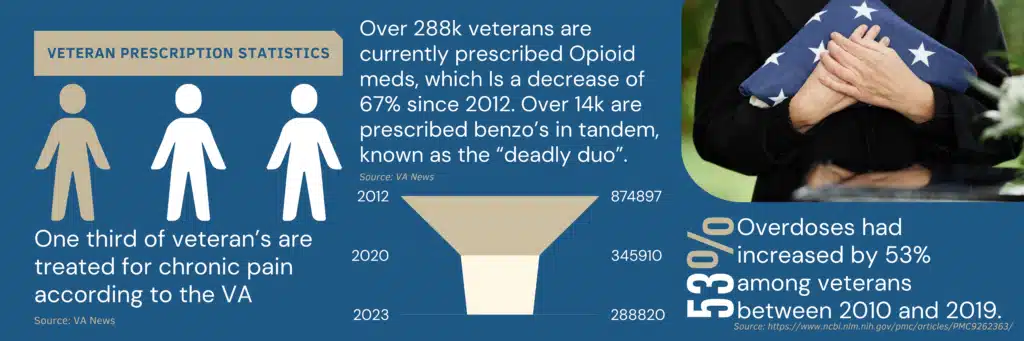
According to the VA, 1 out of 3 veterans are treated for chronic pain. Since 2012, the VA has decreased the number of opioid prescriptions by 67%, yet the overdose rate of veterans has increased by 53% (as of 2019). Opioid prescriptions are prescribed over 288k still and over 14k veterans are also prescribed benzodiazepines, known as the “deadly duo” due to their exponentially heightened risk of overdose when combined. Many people generally when they cannot receive prescription opioids for various reasons (costs, doctor refusals, supply, etc..) will turn to less predictable illegal drugs such as Heroin or Fentanyl, leading to increased overdose risk and mortality.
The three classes of the most abused prescription drugs are opioids, depressants, and stimulants. Doctors closely observe these classes and try not to over-prescribe them due to their addictive qualities.
Opioids and opiates are some of the most widely abused prescription drugs, and they’re responsible for the majority of overdose fatalities. Doctors prescribe opioids for chronic to severe pain, usually after an accident or injury. Opioids block pain receptors in the body, causing you to feel euphoria and pleasure, and in turn, can lead to dependency and addiction and cause withdrawal if stopped suddenly. The most commonly prescribed opioids include:
Though the two terms are often used interchangeably, they are in fact different. All opiates are technically opioids. This is because the definition of an opioid is essentially any drug compound that acts on the opioid receptors in the body—as both opioids and opiates do. While all opiates are opioids, not all opioids are opiates.
Opiates are only opioids whose chemical compounds naturally come from the opium poppy plant. The other opioids that aren’t opiates are either synthetically made in a lab or partially natural and partially synthetic. There are numerous effects of opioid and opiate addiction with both physical and mental challenges brought on with continued use.
Depressants slow down bodily functions and are extremely helpful in treating people with anxiety and panic disorders. However, patients can get used to their calming effects and abuse them. People who don’t have anxiety disorders also enjoy the effects of these medications for recreational use. Depressants carry a high-risk of addiction and increase the risk of overdose or other challenges in people using depressants in combination with other drugs.
Benzodiazepines are prescription medications used to treat mental health conditions such as anxiety and panic disorders. They also assist in the treatment of insomnia, muscle spasms, seizures, and withdrawal symptoms associated with drug and alcohol addiction. Benzos provide a tranquilizing effect that helps alleviate feelings of anxiety and assists in relaxation and sleep.
While millions of people experience relief by using benzodiazepine medication as prescribed, they still have a high risk of developing an addiction. Due to their tranquilizing effects, many people abuse their prescriptions from the start or take benzos without having a prescription for them. Either way, it is important to seek a medical benzo addiction treatment center such as ours in California.
Sometimes people who are addicted to benzos may recognize their symptoms and attempt to quit ‘cold turkey’. However, this can be dangerous and even fatal, so it is not recommended. A qualified rehab program is staffed by addiction specialists and provides professional services that include round-the-clock supervision to monitor for withdrawal symptoms and ensure the client’s comfort and safety while detoxing.
Quitting benzos cold turkey is usually not successful because withdrawal symptoms are often uncomfortable, resulting in the desire to use again to relieve their symptoms. Furthermore, people who attempt to quit benzos on their own are more likely to relapse, compared to those who take advantage of a benzodiazepine rehab program.
Klonopin or is a benzodiazepine used to treat anxiety and panic disorders. It is highly addictive and can lead to dependency if used for extended periods. The withdrawal from Klonopin can be severe, highlighting the need for medical supervision during the benzo rehab process
Xanax is another benzodiazepine that is highly addictive. People who develop a dependency on Xanax often require professional rehab services to safely detox and manage withdrawal symptoms. It’s essential to seek Xanax treatment early to avoid the severe consequences of prolonged abuse. Xanax withdrawal treatment from home can have dangerous outcomes, including death, which is why it is never recommended to detox from Xanax without medical supervision.
Stimulants speed up certain bodily functions. These release chemicals in your brain that produce feelings of reward and attention. Doctors prescribe stimulants to patients struggling with attention-deficit disorder or attention-deficit hyperactivity disorder (ADD and ADHD)
Amphetamine salts and dextroamphetamine are both used to treat ADHD. Amphetamine salts are a combination of dextroamphetamine and levoamphetamine, providing a balanced effect. Dextroamphetamine is a more potent stimulant and is often used for more severe cases of ADHD.
Amphetamine and methylphenidate are both stimulant medications but work in slightly different ways. Amphetamine increases the release of dopamine and norepinephrine in the brain, while methylphenidate blocks their reuptake, increasing their levels. Both medications can be addictive and require careful monitoring by a healthcare professional.
Methylphenidate, commonly found in medications like Concerta, is addictive and can lead to dependency if not used as prescribed. Addiction to methylphenidate can cause significant withdrawal symptoms, making it crucial for individuals to seek professional treatment if dependency develops.
California has faced tragedy as prescription opioid use has wreaked havoc on the state’s residents. In 2018, almost 2,500 Californians lost their lives to opioid-related overdoses. This accounted for 45% of the state’s drug overdose deaths.
This epidemic does not end in California, it affects the entire nation. The most recent study showed in 2023 the US had over 100,000 overdose deaths, primarily involving opioids—which comprise the majority of all overdose fatalities.
Purchasing prescription drugs off the street has become increasingly difficult. According to the DEA, 7 out of 10 street-purchased prescription drugs tested contained a potentially lethal dose of fentanyl. These drugs are often illicitly pressed rather than pharmaceutically manufactured, resulting in unpredictable and hazardous compositions. Fentanyl, which is 50 to 100 times more potent than morphine, dramatically raises the risk of overdose and death, especially when mixed with other substances.
Treatment at California prescription drug rehab centers starts with a client evaluation. The purpose of the evaluation is to give staff members a profile of the client’s addiction and circumstances. If necessary, a client will then undergo detox. Upon completing detox, the client will transition to a program that combines evidence-based and holistic therapies. These programs include:
In the early days of recovery, many individuals are reluctant to trust their instincts. As they navigate everyday life, they sometimes feel they need extra support to avoid relapsing. Due to this, our prescription drug rehab center will ensure clients leave with access to aftercare resources.
Aftercare programs can encompass several options. In a pinch, the client will always have the option to participate in outpatient counseling. For the longer term, the individual might want to participate in some form of support group/program. If the individual is not ready to fully integrate into society, a sober living arrangement might be necessary. Types of aftercare include:
Methamphetamine is more potent and addictive than amphetamine, Methamphetamine does have a prescription form called Desoxyn, but is primarily illegally manufactured and used. Amphatemines are less potent and are frequently prescribed to treat ADD and ADHD, but both carry a very high risk of dependency and addiction.
Yes, amphetamines are highly addictive and can lead to dependency if misused.
Methylphenidate is addictive and can cause dependency if not taken as prescribed.
Signs of Klonopin addiction include increased tolerance, withdrawal symptoms, and an inability to stop using despite adverse consequences.
Yes, Xanax is highly addictive, and prolonged use can lead to severe dependency and withdrawal symptoms which can be fatal. Xanax and other benzodiazepines should only be taken when needed and never as a daily anxiety treatment.
The best treatment includes a combination of medical detox, evidence-based therapies, and holistic approaches, tailored to the individual’s needs.
While codeine is considered a mild opiate, it’s still possible to overdose on it and it can even be deadly. This is because opiates depress the central nervous system which can cause issues with the heart and respiratory system.


There is a multitude of benefits associated with the comprehensive drug rehab care we offer in sunny California. The most noteworthy of these is living a life free of the harmful physical, mental, and social effects of addiction.
Further benefits of receiving treatment at our drug rehab in Southern California include the following:
These benefits are why our programs lead to successful outcomes for many in recovery. By offering varying levels of care, therapies, and amenities, we have something for everyone in recovery.