
Rehab programs that can be individualized for a first responder are necessary and vital to our society. First responders are the first ones to show up during a crisis or an emergency situation and they are usually the last to leave. An emergency responder is also one of the most grueling and mentally taxing jobs in society as well. They see things that nobody should have to see and are put in situations that no amount of training can prepare you for. To cope with the stress, many of them end up abusing drugs or alcohol. Because of this, many addiction treatment programs offer rehab programs for first responders to help those who are on the front line as part of their profession.
Trustindex verifies that the original source of the review is Google. After 35 years of drinking I HAD to put myself through treatment. I tried to quit on my own but only got sick. Never been through a program before but glad it was here. Staff and counselors were very good and easy to talk to. Meals were good n plenty and then some. Thank you for helping me get my life back on track.Trustindex verifies that the original source of the review is Google. This is a great program. I love the staff here especially shep. He was a cornerstone to my recovery here. All the staff was great. But shep was definitely my rock hereTrustindex verifies that the original source of the review is Google. It feels impossible for me to adequately put into words what Phoenix Rising and their staff means to me. It’s been 9 months since I arrived there, totally broken, hopeless, scared, sick, sad, and ashamed. I was on the verge of death, either by suicide or my failing health due to my addiction and total breakdown. And now, I have hope, I have sobriety, and my life back. Their program is so special and so well rounded. They think outside of the box with their treatment and make mindful accommodations when necessary. Aside from the usual offerings of therapy, trauma work, 12 step meetings and sober fun days outside of the facility, there is meditation and sound baths, misc outings (hello mani pedi day and softball) and hiking, beautiful pools to swim in, art therapy, writing therapy, and so much more. You learn the science and psychology of addiction, trauma and recovery. You are fed delicious food. Most importantly, you are surrounded by a staff who cares so much. Whomever is responsible for their hiring has a true gift for choosing the right people. If you’re reading this and wondering, please go. Go to this safe, healing place. Go with an open heart, open mind, and willingness. Save yourself. Save your life. Heal. Learn. Grow. Thank you Genevieve, for being the incredible backbone of the facility. Thank you Candice, for being my mama goose- for your warm hug and telling me “you’re home now. You’re safe” as I exited the car crying and defeated on my arrival. Thank you Brie, Chelsi, Jordan, Meditation Mark, and Michelle. I remember and cherish you all. I’m so thankful for you. I’m doing well guys!!! I’m hiking and dreaming and working and cherishing all the things I love!!! I am alive.Trustindex verifies that the original source of the review is Google. This place was amazing! I didn't think I needed treatment until I got here! They changed my life in so many ways. It was a challenge but the team is very personal in what they do that it was no challenge for them. Thank you Phoenix Rising for a better way of living!!!!Trustindex verifies that the original source of the review is Google. My name is Raquel I am a Phoenix rising alumni ,I was addicted to meth for more than 35 years I was blessed to be accepted at la Quinta house on a full scholarship.At Phoenix rising I received the best treatment the staff there was so amazing and caring they really cared about me When I had stopped caring,the staff helped me to see that I could make the changes needed to have a healthier happier life .The director,the counselors ,the therapist ,med Tech's and all other staff made me feel like family like I was worth saving.Im now living my best life sober in ARROWBEAR lake California I've got 9 months clean and going.Thank you phoenix rising for showing me a better way of living and teaching me how to reach my goals living my life without meth,I now wake up feeling free👍💯🥰Trustindex verifies that the original source of the review is Google. My kiddo spent time at Phoenix Rising in 2025. The staff was attentive and caring and was continually going the extra mile. The rehab home was very nice and comfortable. My kiddos shared that he had the best therapist he has ever had and he’s had quite a few. The drug and alcohol counselor was also outstanding. Highly recommend!Google rating score: 4.7 of 5, based on 102 reviews
A first responder is someone who shows up first to help out in a situation that requires professional help. They can be police officers, firefighters, EMTs (emergency medical technicians), paramedics, or even government officials. Due to the nature of their jobs, first responders experience situations on a daily basis that the average citizen can’t even imagine. They see and experience traumatic events such as death, dismemberment, rape, and abuse. They’re even the ones that have to tell someone that a family member or loved one of theirs has died.
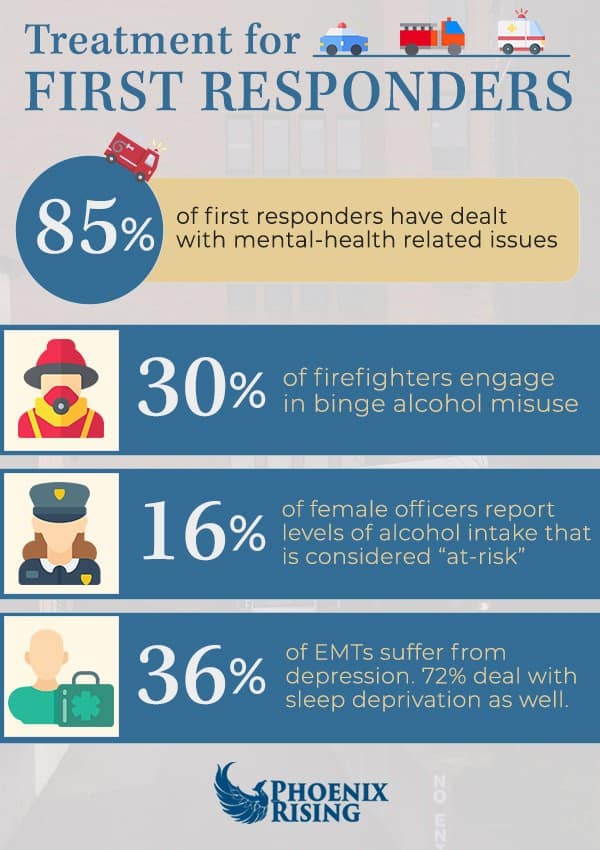
The mental toll that being an emergency responder can have on a person can lead to the development of mental health issues and even substance abuse. In fact, studies have shown that about 85% of first responders have endured mental health-related issues, and 34% were diagnosed with a mental health disorder, with PTSD and anxiety being the most common mental health disorders.
Due to the nature of their job and the mental toll it takes, many first responders turn to drugs and alcohol to numb their pain and forget about the things they’ve seen. More often than not, this can lead to the development of a drug or alcohol addiction, resulting in a co-occurring disorder. Luckily, there are rehab programs specific to first responders.
First responders are often cited as heroes in their communities and with good reason. Law enforcement officers, firefighters, EMTs, and paramedics all deserve the accolades they receive but many outsiders don’t know that their jobs are some of the most grueling and mentally taxing occupations in society.
First responders see and experience traumatic events such as accidents, murder, severe injuries, sexual and physical assault, domestic abuse, civil unrest, and natural disasters. The mental toll that being an emergency responder can have on a person often leads to the development of mental health issues and even substance abuse.
Studies have shown that about 85% of first responders have endured mental health-related issues, and 34% were diagnosed with a mental health disorder. Post-traumatic stress disorder (PTSD) and anxiety top the list of mental health issues they face. The prevalence of so much job-related suffering makes first responder rehab a necessity for many people.
While any of the first responder jobs can expose employees to traumatic and stressful events, certain members of the population face specific risks when it comes to developing a substance use disorder.
Every time a firefighter goes to work, they potentially risk their lives. They juggle battling fires and other dangerous situations with trying to save others and keep themselves safe. Firefighters are susceptible to physical injuries like severe burns, smoke inhalation, and lung damage. They work long shifts away from their homes and are at great risk of developing mental health issues such as PTSD, acute stress disorder, depression, and anxiety.
It’s common for firefighters, as a result of the stress and strain of their jobs, to turn to drugs and alcohol. About 30% of all firefighters engage in some form of binge drinking or alcohol abuse; another 10% engage in prescription drug abuse. A number of factors lead to abusing substances, including acts of camaraderie and peer support as a way to “wind down” after work.
EMTs and paramedics are often dispatched in situations where immediate medical attention is required. This can include things like car accidents, personal injuries, shootings, overdoses, someone going into cardiac arrest, and any other potentially life-saving situations. EMTs and paramedics have to make split-second decisions that can result in either saving someone’s life or that person dying.
As a result, the mental toll that an EMT or paramedic can experience is extreme. According to the Substance Abuse and Mental Health Services Administration, 36% of EMS workers suffer from depression, 72% of EMTs deal with sleep deprivation, and more than 20% of EMTs suffer from PTSD.
All of these increase the risk of an EMT or paramedic developing a substance abuse issue. While police officers are more likely to abuse alcohol than any other type of emergency responder, paramedics and EMTs are more likely to turn to drugs.
Substance use disorders include addiction to alcohol and several different types of drugs. They include:
The initial step in first responder rehab is undergoing detox. During detox, you will rid your body of all the harmful substances that it has grown dependent on. Because of the physical and mental toll that detoxing can take, it is important that it be done under constant medical supervision. Detoxing can be done at a hospital, a dedicated detox facility, or a treatment facility that also offers detox services.
After detox has been completed it will be time to enter either an inpatient or outpatient treatment program. During treatment, any mental health issues will be addressed along with the substance abuse issue. This is typically done through a variety of therapy sessions including:
First responders will typically be grouped with other first responders during group therapy sessions since their issues are unique compared to the general population. Our addiction treatment program in Palm Springs, California allows each first responder to focus on their own well being by:
As a result, co-occurring disorders such as a mental health condition and substance abuse are common amongst first responders. What’s not as common is these first responders getting the help that they need to address their issues. Many are afraid to accept that they have a problem. They might be embarrassed or think that it is a sign of weakness. It’s important to remember that you should never feel ashamed or embarrassed when it comes to getting the help that you need.


There is a multitude of benefits associated with the comprehensive drug rehab care we offer in sunny California. The most noteworthy of these is living a life free of the harmful physical, mental, and social effects of addiction.
Further benefits of receiving treatment at our drug rehab in Southern California include the following:
These benefits are why our programs lead to successful outcomes for many in recovery. By offering varying levels of care, therapies, and amenities, we have something for everyone in recovery.