
Ibogaine has gained attention as a potential option for people struggling with opioid dependence, trauma, and other complex mental health challenges.
Is ibogaine actually legal in the United States? The short answer is no. But the full picture is more nuanced, especially with recent policy changes in 2026.
Current Legal Status of Ibogaine in the U.S.
As of 2026, ibogaine is classified as a Schedule I controlled substance under the Controlled Substances Act.
That classification means:
- It is considered to have no accepted medical use
- It carries a high potential for misuse
- It is illegal to possess, distribute, or administer in the United States
Unlike substances like psilocybin or cannabis, which have seen state-level reform, ibogaine has not been legalized or decriminalized in any U.S. state.
In practical terms, that means you cannot legally receive ibogaine treatment within the United States outside of very limited, approved research settings.
Why People Still Seek Ibogaine Treatment
Even though it’s illegal domestically, ibogaine is still being used in other parts of the world, particularly in countries like Mexico, where treatment clinics operate legally.
Many individuals travel abroad because early research and patient reports suggest ibogaine may:
- Reduce withdrawal symptoms
- Interrupt opioid dependence cycles
- Provide deep psychological insight
That said, it’s important to understand that ibogaine is not FDA-approved, and its safety profile is still being studied. Risks like cardiac complications have been documented, which is part of why regulation remains strict.
Table 1. Current Knowledge of Ibogaine Outcomes in Opioid Treatment (At a Glance)
| Outcome Measure | Reported Result | Study Context |
|---|---|---|
| Withdrawal symptom relief | ~80% reported elimination or major reduction | Global survey of ibogaine users with opioid dependence |
| Reduction in opioid cravings | ~50% reported reduced cravings | Same survey data across international users |
| Sustained craving reduction (3+ months) | ~25% reported lasting reduction | Follow-up self-reports post-treatment |
| Short-term abstinence (1 month) | ~50% reported no opioid use | Observational clinical data |
| Mid-term abstinence (3 months) | ~33% reported no opioid use | Same cohort follow-up |
| Long-term abstinence (6–12 months) | ~30–41% reported abstinence | Survey + follow-up studies |
| Complete cessation after treatment | ~30% reported never using again | Self-reported long-term outcomes |
| Overall effect on opioid use | Significant reduction or cessation in many participants | Longitudinal observational study (12 months) |
2026 Update: Federal Policy Is Starting to Shift

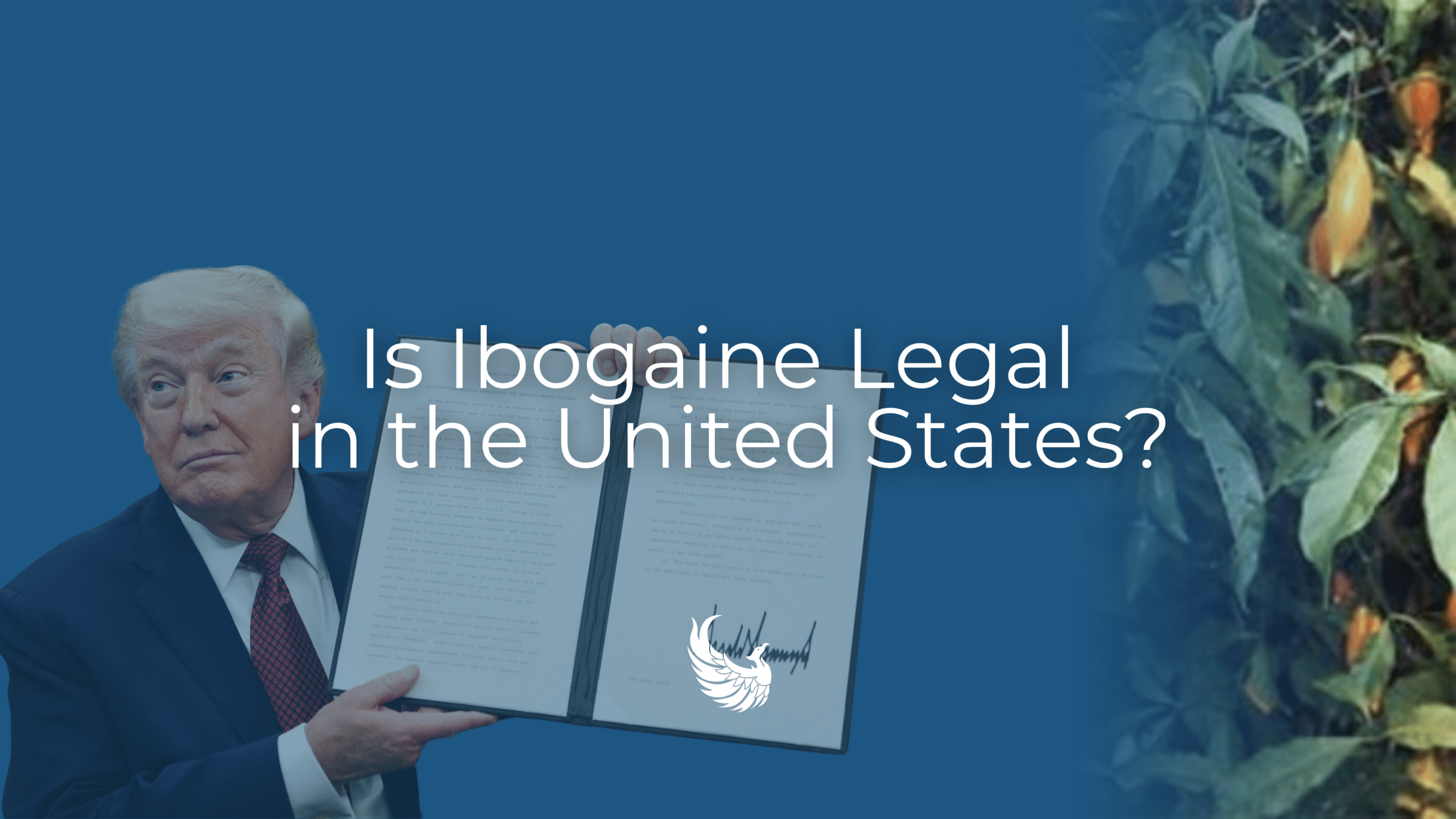
Photo credit: Julia Demaree Nikhinson / Associated Press.
In April 2026, a major shift began at the federal level.
The U.S. government signed an executive order to accelerate research into psychedelic treatments, including ibogaine. This does not make ibogaine legal, but it does signal a change in direction:
- Federal agencies are being directed to expand research access
- Funding is being allocated for clinical trials, including state-backed programs
- There is growing interest in ibogaine for PTSD, depression, and dependence-related conditions
Some key takeaways from this shift:
- Ibogaine is still illegal today
- Research barriers are being reduced
- Future medical approval is possible, but not immediate
Can You Legally Access Ibogaine in the U.S.?
Right now, access is extremely limited.
You may encounter clinical trials operating under FDA approval pathways, and potential future access through “Right to Try” frameworks (still developing). But for the average person, there is no legal way to receive ibogaine treatment in the U.S. today.
Why Is Ibogaine Illegal in the United States?
Ibogaine is illegal in the U.S. primarily because of how it’s classified under the Controlled Substances Act. Under that law, ibogaine is listed as a Schedule I substance, which is the strictest category. That classification is used for substances that are considered to have a high risk and no accepted medical use at the federal level.
There are a few key reasons it ended up there.
First, there hasn’t been enough large-scale, FDA-approved research to prove that ibogaine is both safe and effective. Without that kind of data, the U.S. Food and Drug Administration does not recognize it as a medical treatment.
Second, there are real safety concerns. Ibogaine has been linked to serious heart-related complications, especially in people with underlying conditions or without proper medical screening. That risk has made regulators cautious about allowing broader access.
Third, most of the evidence around ibogaine comes from small studies, observational data, or treatment settings outside the U.S. That kind of data can be promising, but it’s not enough on its own to change federal classification.
So the short version is this. It’s not illegal because it’s been proven ineffective. It’s illegal because it hasn’t yet met the standards required to be considered safe, consistent, and medically approved in the United States.
Where Can You Get Ibogaine Treatment?
Because ibogaine is illegal in the United States, most people who pursue it end up looking outside the country. And that’s where things get a little complicated. It’s not just about where it exists, it’s about where it’s actually allowed, accessible, and being used in real treatment settings.
The Main Countries Where Ibogaine Treatment Is Available
Right now, there are a handful of countries that have become known as hubs for ibogaine treatment. Each one falls into a slightly different legal category.
Mexico
Mexico is by far the most common destination, especially for people coming from the U.S. Ibogaine is not specifically regulated there, which has allowed clinics to operate openly.
That’s why you’ll see a large concentration of treatment centers in places like Baja California. It’s accessible, relatively affordable, and has built a reputation as the primary global hub.
Costa Rica
Costa Rica is another major destination. There are no clear legal restrictions on ibogaine, which has allowed retreat-style and medically supervised programs to operate.
Programs here tend to be more structured and often marketed as higher-end or private treatment experiences.
Portugal
Portugal has emerged as a quieter but growing option. While not fully regulated, it operates in a more permissive environment that allows certain treatment centers to exist.
Brazil
In Brazil, ibogaine is allowed under medical supervision with a prescription. That makes it one of the few places where it can exist inside a more formal healthcare framework.
New Zealand
New Zealand also permits ibogaine as a prescription medicine, meaning it can be administered legally in specific clinical contexts.
South Africa
South Africa allows ibogaine in controlled settings, typically through licensed providers or medical oversight.
What This Means for People Seeking Treatment
This is where things get important.
The growing interest in ibogaine reflects a real need. Many people are looking for alternatives because traditional approaches haven’t worked for them.
But legality matters for a reason.
In the U.S., licensed treatment programs are required to:
- Use evidence-based therapies
- Provide medical supervision and safety protocols
- Offer continuity of care and long-term support
Those are not always guaranteed in unregulated settings, especially outside the country.
A Grounded Perspective
Ibogaine sits at an interesting intersection right now.
It’s not legally available in the U.S., but it’s also no longer being ignored.
The current reality looks like this:
- Illegal under federal law
- No state-level legalization
- Active clinical research underway
- Increasing political and medical interest
- Potential future pathway to approval
But that future is still developing, and for now, ibogaine remains outside the scope of legal treatment options in the United States.
Sources
- Alper, K. R., Stajic, M., & Gill, J. R. (2012). Fatalities temporally associated with the ingestion of ibogaine. Journal of Forensic Sciences, 57(2), 398–412. Retrieved from https://pubmed.ncbi.nlm.nih.gov/22268458/
- Brown, T. K. (2013). Ibogaine in the treatment of substance dependence. Current Drug Abuse Reviews, 6(1), 3–16. Retrieved from https://pubmed.ncbi.nlm.nih.gov/23627782/
- Brown, T. K., & Alper, K. (2018). Treatment of opioid use disorder with ibogaine: Detoxification and drug use outcomes. The American Journal of Drug and Alcohol Abuse, 44(1), 24–36. Retrieved from https://pubmed.ncbi.nlm.nih.gov/28541119/
- Ingham, J. (2026). Where Can You Get Ibogaine Treatment? Retrieved from https://brookshealingcenter.com/blog/where-to-get-ibogaine/
- Food and Drug Administration. (n.d.). Development & approval process. Retrieved from https://www.fda.gov/drugs/development-approval-process-drugs
- Global Ibogaine Therapy Alliance. (n.d.). Clinical guidelines for ibogaine-assisted detoxification. Retrieved from https://ibogaineguidelines.com/
- Koenig, X., & Hilber, K. (2015). The anti-addiction drug ibogaine and the heart: A delicate relation. Molecules, 20(2), 2208–2228. Retrieved from https://pubmed.ncbi.nlm.nih.gov/25642835/
- National Institute on Drug Abuse. (n.d.). Psychedelic and dissociative drugs. Retrieved from https://nida.nih.gov/research-topics/psychedelic-dissociative-drugs
- Noller, G. E., Frampton, C. M., & Yazar-Klosinski, B. (2018). Ibogaine treatment outcomes for opioid dependence from a twelve-month follow-up observational study. The American Journal of Drug and Alcohol Abuse, 44(1), 37–46. Retrieved from https://pubmed.ncbi.nlm.nih.gov/28402682/
- Reuters. (2026, April 17). Trump set to ease restrictions on psychedelic drug used to treat PTSD. Retrieved from https://www.reuters.com/legal/litigation/trump-set-ease-restrictions-psychedelic-drug-used-treat-ptsd-2026-04-17/
- The White House. (2026, April). Accelerating medical treatments for serious mental illness. Retrieved from https://www.whitehouse.gov/presidential-actions/2026/04/accelerating-medical-treatments-for-serious-mental-illness/
- The White House. (2026, April). Fact sheet: President Donald J. Trump is accelerating medical treatments for serious mental illness. Retrieved from https://www.whitehouse.gov/fact-sheets/2026/04/fact-sheet-president-donald-j-trump-is-accelerating-medical-treatments-for-serious-mental-illness/